Showing posts with label Representation. Show all posts
Showing posts with label Representation. Show all posts
Friday, 8 March 2019

Thursday, 17 January 2019
Sunday, 29 July 2018
Friday, 22 June 2018
Thursday, 21 June 2018
Thursday, 22 March 2018
Institutional Factors and Marketing
First published in
1991 The Big Issue has gone from strength to strength
to become the world’s most widely circulated street newspaper. It
officially belongs to the hybrid genre of entertainment and
social business and as such, runs regular reviews on films, book releases,
theatre, music and art but no television listings – the entertainment aspect
attracts advertising revenue while the editorial
content is often critical of big business, banking and commerce and
champions the political cause and role of the individual within society. David
v Goliath narratives are common as downtrodden groups and disparate individuals
fight corporate giants but the magazine has come under some criticism for its
‘flashy style’ as a street newspaper and as being overly commercial.
When John
Bird and Gordon Roddick founded the magazine their aim was to offer homeless
people, or people at risk of homelessness the opportunity to earn a legitimate
income by selling the magazine – the cost of the magazine is £2-50 with £1-25
going to the trader. This was the primary objective of the magazine as an independent
publication to offer a public service and to try and improve a social
problem which they saw as endemic – John Bird MBE remains the Editor-in-Chief
and still writes a regular column at the back of the magazine. Recently
(January 2013) he appeared on BBC1’s discussion panel show Question
Time surprising some viewers with his admission that he is a ‘working
class Tory’. Other writers in the magazine Bird works with include professional
journalists and new and established writers.
Bird’s own
background was pivotal to launching The Big Issue – he
was homeless at the age of 5, residing in an orphanage between 7 and 10 and had
a spell in prison as a teenager. After leaving prison he slept rough on the
streets of London before returning to prison in his late 20s. Four years after
founding the magazine in 1995 he launched The Big Issue Foundation,
a registered charity to further help the homeless. The Foundation provides
magazine vendors with information, advice, guidance and support on a range of
issues.
As an
independent publication (published by The Big Issue Company Ltd.)
it needed, and received £25,000 start up capital, donated by The
Body Shop (the founder of the Body Shop, Anita Roddick was the
wife of co Big Issue founder Gordon Roddick). At its
peak The Big Issue sold 300,000 copies in 2001 but as
sales declined over the decade (along with the circulation of
all print media) it re-launched with a new look and new columnists including
controversial Premier League footballer Joey Barton. Weekly circulation (every
Monday) has improved to around 58,000 and presently there are 6000 registered
sellers all over the UK with acknowledgement that there are also rogue traders
(without large red jackets and clear id badges) who have ‘acquired’ copies of
the magazine illegally. Most of the vendors conform to the male (85%)
homeless stereotype, are 18-46 with broken relationships and
subsequent problems given and the major reason for their homelessness
Audience Appeals
Undoubtedly there is an element of emotional fulfilment in
buying a copy of The Big Issue – this feel good factor
associated with charity giving has to be identified as one of the key appeals
of the magazine. In making a purchase you may feel better ideologically knowing
you are helping rough sleepers and the homeless. This is why ‘carers’ using
psychographic research are targeted by the magazine. Using a different model of
audience, the Uses and Gratifications model Surveillance very
much applies as one of audience pleasures gained from reading the magazine.
Information is available on socio political issues but also the entertainment
aspect in that you can read about a current issue but then indulge in reviews
and analysis of culture.
The target audience of The Big Issue also
enjoy the fact that it speaks to them, in terms of modes of address ‘in
their own language’ using an elaborated language code assuming
a level of intelligence and cultural capital. This balanced
approach cloaks up to a point any encoded ideology and
massages carefully the readers’ understanding of key issues. Articles and
stories assume some prior knowledge e.g. in the edition October 8th 2012 a
piece on the American Presidential Debate required some knowledge of the
American constitution and political history. Shared ideological beliefs is also
a key appeal for the audience as notions of personal relationships apply – in
the same edition an ironic advert for ‘Dick Sapphire’ lectures on how to make
money targets the audience’s left wing, liberal leanings as they are aware the
lectures are written and performed by comedian Rory Bremner, known for his
strong political opinions on issues ranging from Health Care to Education and Politics.
These are all areas audiences would expect The Big Issue to
cover.

The reader is made to feel
‘independent’ by the reactionary, sometimes controversial approach the magazine
has, against dominant mainstream culture. Even the adverts do not
follow mainstream conventions with copy including National Book Tokens, ‘Let’s
Trek for Children’ and Safer Medicines. There is an
element of the alternative here with the caring, liberal audience appreciating
the lack of adverts for high street brands whose primary objective is
commercial gain. Along with this, even the celebrities found within the
magazine are associated with more realist human interest stories while at the
same time remaining aspirational as figures the target
audience can identify with and relate to.
The central story, “What’s your
Revolution?” is a rhetorical question challenging the target
audience making clear linking to the Communist Russian Revolution – this is an
attempt by the magazine to return to left wing political values.
• The
connotations of the Russian Revolution are evidenced by intertextual reference
to Constructivist art which references the cultural capital of
an ABC1 demographic – the fist, stars and design are common to this art
movement.
• “Time
to make a change” has a double meaning by referencing a need for political
change but also by referring directly to new writers – Alex Salmond as leader
of the SNP has obvious credentials to write for a politically motivated
magazine, Bob Crow is the reactionary, left wing General Secretary of the RMT
known for bringing railway workers out on strike while the Archbishop of York
is an outspoken block cleric on issues of multiculturalism and homosexuality.
The controversial Premier League footballer Joey Barton is included as a
controversial figure who has been subject to considerable criticism and media
speculation.
• Dame
Stephanie Shirley is the only female writer on the front cover which anchors
the male dominated narratives and viewpoints contained within the magazine –
Dame ‘Steve’ Shirley (adopting the name Steve to help her in the male dominated
business world) is a businesswoman and philanthropist whose work has focussed
on creating work opportunities for women with dependents.
Genre
• As
a hybrid magazine of
entertainment and social business key entertainment conventions include reviews on
television, film, book releases, theatre, music, the arts (see some display
adverts). As identified before these entertainment aspects draw in advertising
revenue as this is one of the key appeals of the magazine (see above). Front
covers are nearly always entertainment based with frequent use of celebrity to
anchor a narrative –
see front page deconstruction below. The Big Issue remains an unusual hybrid as entertainment
magazines are rarely hybridised with social business and as such this positions
the magazine as having a USP.
• In
terms of social business, the magazine runs so called ‘serious stories’ –
social issues e.g. AIDS in Africa, Wikileaks, liberal politics, ‘David and
Goliath’ stories which commonly focus on individuals and their struggle against
corporations in classic binary
opposition. Definitions of social business are businesses that are
associated with working for the benefit of the people e.g. Charities,
Education, Healthcare, Housing…This is clearly identifiable as a key convention
of The Big Issue as
it places this as an ideological imperative. Businesses foregrounded often
associated with a more caring approach include Virgin, Innocent
Smoothie, Co-op Bank, Organic Milk, National Book Tokens, Skillset and the University of the Arts. Critical of
big business, banking and commerce the articles are often anti-government,
state control and use of power. Despite the unusual hybrid The Big Issue retains some of its
generic features including regular articles at the back of the magazine by John
Bird and a guarantee of a ‘big splash’, colour cover that is challenging and
provoking.
Representation
• Pluralistic representations
reflect the fact that the magazine is independent – it offers a diverse range
of representations but a key focus on minority groups e.g. the homeless which
positions it as a media text that like The Guardian,
foregrounds narratives about minority groups. Connotations of
being politically liberal and socially aware and against mainstream
representations are written into the magazine despite the prior admission as
identified earlier of John Bird’s Conservative political sympathies. The
Big Issue wants however to be seem as the antithesis of
right wing political ideology and this is evident from front covers
and content analysis.
• In
relation to gender the magazine has a male dominated narrative despite
the alleged 59% readership (according to The Big Issue). I
personally rarely see the magazine purchased by female consumers and the
content seems to stereotypically target ‘male issues’. This is a problem
for The Big Issue as it wants to appeal to both
genders. The magazine is sold not exclusively but commonly by male vendors and
homelessness in terms of statistics is a ‘male problem’. As difficult as these
statistics are to interpret there are many, many more homeless males in the UK
than female and as a result ABC1, educated male consumers are more likely to be
aware of this.
• Representations
of Age is interesting - The Big Issue allegedly has a
younger target audience according to the magazine’s own demographic analysis
but many articles suggest a need for cultural capital associated with an older
demographic e.g. one article on William Shatner as James T Kirk would present
‘problems’ for a younger reader. In this regard however statistics indicate
that homeless people in the UK are more under 45 than over 45 with a
significant percentage under 35. Representation of art and culture are
preferred to mainstream entertainment which again would stereotypically attract
an older audience with a positive focus on representations of working class
culture despite the middle class readership.
• Compared
to any genre of magazine The Big Issue has low
production values but compared to most other so called Street
Magazines has higher production values. Again, as with most magazines The
Big Issue is sustained by advertising revenue and
by The Big Issue Foundation and supported by www.bigissue.com. The cover is often
flamboyant, revealing a high level of cultural and political awareness (see
above covers which use intertextual links to an Alfred
Hitchcock film to link to budget cuts and debate on the power of
television) but also understanding the cover is the main point of sale. The
Big Issue is sold (points of distribution) in city
centres, built up urban areas, train stations and shopping centres with the
bulk in London where there is a high percentage of Romanian vendors. The
magazine, although dealing with national issues is up to a point globally
published being available in Australia, Japan, South Africa, South
Korea, Namibia, Kenya, Taiwan and Malawi where content is bespoke to country
and culture.
Monday, 12 March 2018
Magazine introduction
The Big issue
'hand up not a hand out' 'We are a social business not a charity'- Media language is camera, editing, sound, mise en scene (CLAMPS)
- Social, cultural and political contexts.
- Need to know 2 front covers of the big issue.
- Alternative to mainstream
- Talk about:
-Typography
-Camera
-Props
-Lighting
-Makeup
-Clothing
- Niche audience- narrow group of readers with a particular interest
- Mass audience- readership on a large scale
- Masthead- the title of the magazine
- Puff- a story that is given prominence on cover
- Coverstar- 'star' featured on the cover
- Anchorage text- text that anchors the main image and gives it meaning/context.
- Intertextuality
- 1991- started (it gave people a chance to make a difference)
- Brought homeless/less wealthy for £1.25 each to resell for £2.50
- Gordon Roddick and John Bird began the big issue
- 2000 big issue venders
- Relies on sponsorship and circulation revenue
- About 100,000 are sold in Britain each week
- Entertainment and social business
- 'Ethic capitalism'- John Bird
Thursday, 4 January 2018
Gilette advert analysis
-Language: Technical, visual, Audio codes (Camerawork, Mise en scene, sound, editing), Narrative, Genre....
The advert immediately begins with the lyrics "you're looking sharp", this grabs the audiences attention who may being watching tv or passing by on the street, also it is linking to the product itself which is a razor which as a buyer you want to be sharp. The next line says "you're looking good", the repetition of the personal pronoun you're is addressing the audience therefore making the advert more relatable and efficient fro the company. By them using the lyrics "we know how to make, the most of who you are" gives the impression that they know you and are looking out for you so you do what is best. All of the words they have used in this context have positive connotations, such as 'sharp'and 'good' which affects the way that the audience portray the product.
There is no conversational narrative during this advert, however there is narrative at the end of it giving information about the product which I feel gives the best overall effect. Each of the scenes show the man as a family man who is ideal and the idea of the 'perfect' person which every man can be is they use Gillette.
The mise en scene is very standard throughout so that it can attract the target audience which is everyday regular men, these have been targeted by the use to simple costumes, low amounts of makeup, high key lighting, minimal actors and everyday settings such as parks, houses and sports grounds. The camera work is also simple and just uses frames which cut and follow the journey of the man.
- Representation: Stereotypes, Encoding/Decoding, Contexts...
The advert consists of a stereotypical family, mum, dad and child. The mum is a stereotypical woman who has the responsibilities of housewife duties, looking after the children and doing everything for the man, such as tying his tie. The dad (The male character) is a stereotypical traditional man, strong, intelligent, role model etc. The child is a stereotypical kid, looking up to his dad, wanting to copy him etc. It appears that the family are reliant on the dad to earn the money and ultimately make the decisions for the family which is the typical stereotype, The context creates is that the family life has improved all thanks to the product.
-Audience: Categories, Mode of address, Response, interaction...
I get the impression that the target audience fro this product are middle aged men who have a family, probably in the A, B, C1, maybe C2 category. This is represented through the male character who is the ideal target audience and suggests that if you don't look like/ feel like him you need to use Gillette and your life will improve and you will have the dream lifestyle. They have integrated with the audience by the use of personal pronouns which are directly addressing the audience, for example 'you' and 'your'.
- Application of theorists...
The theory that applies to this advert would be Stuart Hall and his Reception theory as they would want the viewer to be the dominant audience, the theory that they should believe that if they use this product then they will be the best and their life will change for the better. Other parts of this theory include the negotiated audiences where they believe that the product will be good to use but it wont affect their life as drastically as shown in the advert or the oppositional audiences where they believe that the product wont help them at all and there's no point in buying it. The producers of this advert would hope that most of their audience would be dominant viewers.
Sunday, 3 December 2017
Bias in news examples

Bias by headline and by pictures;
This example shows a play on words 'cor-bin' is giving negative connotations to Corbin and presents Jeremy Corbin in a bin suggesting he is 'rubbish' and trash which shows the papers right wings views towards labour. The photo also influences the readers interpretation of Jeremy because it is showing him in a bin down a local, average street giving the impression that Corbin is common and possibly cannot bring anything different or special to politics anymore than anyone else can.
This representation has been suggested solely by the image and headline without having to read any other information. This is showing the writer/ the suns opinion on Corbin and his place within politics (left wing views).
The second paper is clearly Labour supporters, again this is evident due to the headline and image. An unflattering photo has been used of Theresa May which could be implying the mess she would make of our country. By using a plain back ground the brings the focal pointe and most attention to the image of Theresa May. Then the repetition of the negative word lies before saying Theresa May is showing the papers overall opinion on the Tory's that they lie and are fake.
Other ways to spot bias in the news;
- Camera angles-

In this image for example
- Word choice-

- Bias through choice of Journalist and sources - Who is writing it and what are their beliefs, and who have they got their information from?

- Biased through where the article is in the paper - Is it prominent or hidden? Front page or far back?

- Bias by use of names and titles.

- Bias through statistics and Crowd counts - E.g. 'A hundred injured in air crash' or 'Only Minor injuries in an Air crash.'

Thursday, 30 November 2017
Online news Language
Daily Mail
|
The daily
telegraph
|
|
Who was involved?
|
Ellis Kimmitt (12)
Elliot Kimmitt (14)
Darnell Harte (15)
Anthony Armour (28)
Robbie Meerun (24)
2, 15 year olds |
5 people, among the 5, 3 of which
were children. Two brothers- Ellis and Elliot Thornton (12 and 15), Darnell
Harte (15), two men aged 24 and 28.
|
What happened?
|
Renault Clio, stolen, crashed into a tree killing the 5 victims above.
|
5 People died after a stolen car crashed into a tree.
|
Where did it happen?
|
Stonegate road, Leeds.
|
Stonegate road, three miles north
of Leeds.
|
When did it happen?
|
10pm, 25th of November.
|
Saturday night shortly before 10pm. (25th
November)
|
How did it happen?
|
The car was stolen by two 15 year olds who are now in custody, they crashed into a tree killing 5 victims.
|
2 Boys aged 15 thought to have
stolen a car and drove into a tree killing 5 people, 2 survivors were the
drivers.
|
Why did it happen?
|
The car was stolen and there were 7 people in the car.
|
More information on the matter is required.
|
Sources:
Wednesday, 29 November 2017
Newspaper audience response

- Pro Corbyn
- Anti - Corbyn
- Pro May
- Anti - May
- Pro Trump
- Anti - Trump
- Pro Brexit
- Anti - Brexit
- Immigration
- Muslims
- Refugee Crisis.
- Free schools?
- Rich VS Poor ft. Grenfall
- NHS funding
- Strikes
- Mass Shooting
- US Gun Laws
- ISIS
How do the Newspapers represent the issues/ topics?
Each of the newspapers use large stand out text in either black or white on the opposing colour background, it also includes images which either represent the article positively or negatively.
The first newspaper
The first newspaper
How does the selection of images and language shape and influence the audience?
What is the cumulative effect of these "repeated patterns or representation over long periods?"
Analysis of newspaper front cover
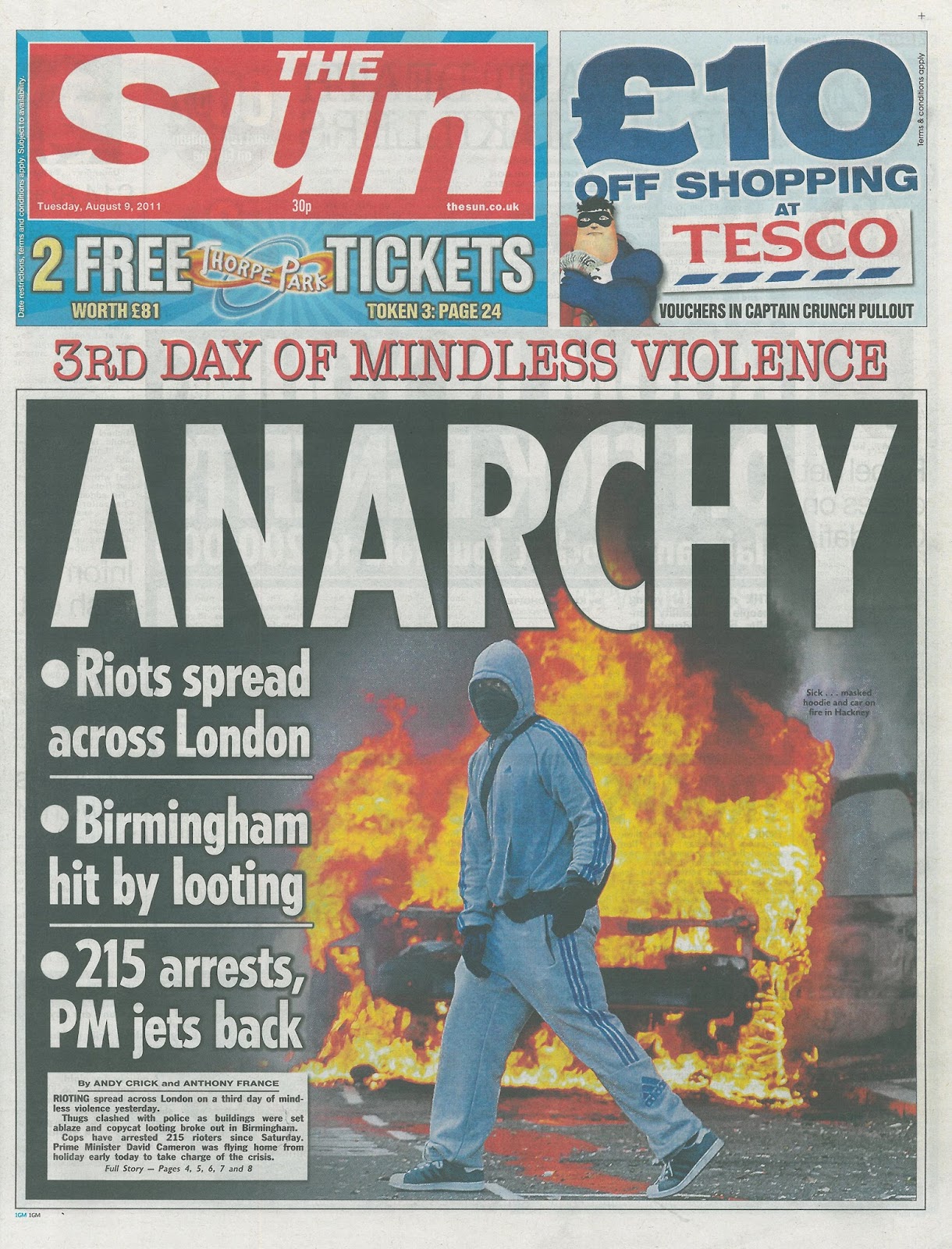
The sun is bright and starts the day.
Mainly C, D, and E.
The representations suggested by this post give the impression that the main image is of a teenager/ youth who has caused trouble in a riot, this immediately makes the reader think negatively of people who look like this and stereotype them to be a certain person and act a certain way. Along with the figure of the man, other key influences which change the way the audience think is the link between the fire behind the man and the key words 'Riots spread across London' the word link could be referring to multiple think; one being the spread of the fire, also the spread of 'thugs' within the riot.
When looking in more detail into the article we find out that the man wasn't a youth at all and was in fact a 35 year old man, also the photo is in fact photos shopped as 2 separate images mixed together to therefore build up more representations and stereotypes.The target audience is represented by the ads based around the main story which suggest a lower class family.

The sun is bright and starts the day.
Mainly C, D, and E.
For this front cover the sun has used a play on words by linking the image to the word 'heel', initially when seeing this I didn't understand how this imaged tied to the story but when you look in more detail 'heel' is something you would command to a horse, so by saying 'heel, boys' it suggests that Theresa has power over them. Giving the representation that Theresa is finally making a stand (can also link to image of her standing) and talking power and authority over the Tories to 'reunite' them and she has the aim to 'deliver Brexit'.
However this could be viewed in a completely different way, such as the shoes representing that women only care about their appearance and how they come across in the public eye. The image emphasises the importance of her appearance.
Similarly the graphology of this cover of her standing on top of the Tory MPs who are beneath her could again be showing her importance and dominance.
Red tops tend to have more modern fonts this for example is using Sans Serif.
Overall the representation of gender in this tabloid cover is very stereotypical in the sense that the appearance of a woman is constantly judged rather than her political achievements. It would be extremely rare that you would see a male leader represented in this way on a front cover of a paper with an image of an item of their clothing with a small, minor image of them in the bottom. Even though sexual dominance is suggested this may not be recognised by all readers as it is under and hard to understand at a quick glance.
Wednesday, 6 September 2017
DR CAGES
Disability
Regional identity
Class
Age
Gender
Ethnicity
Sexuality
Gender -
In this commercial it shows two men at a fast food restaurant which is automatically suggesting that men stereotypically eat fast foods and according to this women don't. The second man then opens his mouth and it has been edited to open extremely wide and just swallow the burger whole, which again suggests that men eat a lot of fast, fatty foods.
This trailer is of two sisters who get trapped in a pool and cant get out. I think this has been done because the idea that men at strong and can do anything suggests that they would be able to get out and survive, whereas by the director choosing two sisters it builds the stereotype of women being weak and fragile.
This trailer shows a female magician in a small swimming costume and heels with a group of men gathering around her shouting and screaming. typically men wear suits whilst doing under water magic tricks, however women stereotypically wear small skinty outfits because it gathers a larger audience.
Counter type-

This man goes against a gender stereotype that only women can wear makeup. Gradually over time it is become more accepted that anyone can wear makeup and just because they are male that doesn't make them necessarily gay. Also it is very common to find that some of the best and most popular makeup you tubers are men, whereas 2 years +ago this wouldn't have been accepted at all.
I think that this ad is another interesting example of gender stereotypes and how age is another factor which will set these stereotypes.
Regional identity
Class
Age
Gender
Ethnicity
Sexuality
Gender -
- Typically women are seen as being housewives and doing very minimal work outside of the household and men are the ones to go out and work, therefore bringing in the income.
- Men stereotypically get the higher paying, more respected jobs such as pilots, doctors, orthodontists, where as women are expected to have jobs as a nurse or teacher.
- People also expect pink to be more of a feminine colour and blue to be masculine.
- Women are expected to wear make up and seen as normal where as men are looked down on and judged because it isn't common.
In this commercial it shows two men at a fast food restaurant which is automatically suggesting that men stereotypically eat fast foods and according to this women don't. The second man then opens his mouth and it has been edited to open extremely wide and just swallow the burger whole, which again suggests that men eat a lot of fast, fatty foods.
This trailer is of two sisters who get trapped in a pool and cant get out. I think this has been done because the idea that men at strong and can do anything suggests that they would be able to get out and survive, whereas by the director choosing two sisters it builds the stereotype of women being weak and fragile.
This trailer shows a female magician in a small swimming costume and heels with a group of men gathering around her shouting and screaming. typically men wear suits whilst doing under water magic tricks, however women stereotypically wear small skinty outfits because it gathers a larger audience.
Counter type-

This man goes against a gender stereotype that only women can wear makeup. Gradually over time it is become more accepted that anyone can wear makeup and just because they are male that doesn't make them necessarily gay. Also it is very common to find that some of the best and most popular makeup you tubers are men, whereas 2 years +ago this wouldn't have been accepted at all.
I think that this ad is another interesting example of gender stereotypes and how age is another factor which will set these stereotypes.
Tuesday, 5 September 2017
Me

I use the previous social media on a daily basis as it allows me to stay in contact with new and old friends or if they live far away it is an easy way to communicate. Also because it allows me to stay up to date on what is going on both online and in the world, from news reports on hurricane Harvey (Facebook/Snapchat-buzzfeed) to what my friends have been doing.
Subscribe to:
Posts (Atom)